

Platform

ERPLens: The AI Workspace Layer for Enterprise Applications

Book a 45-minute architecture session
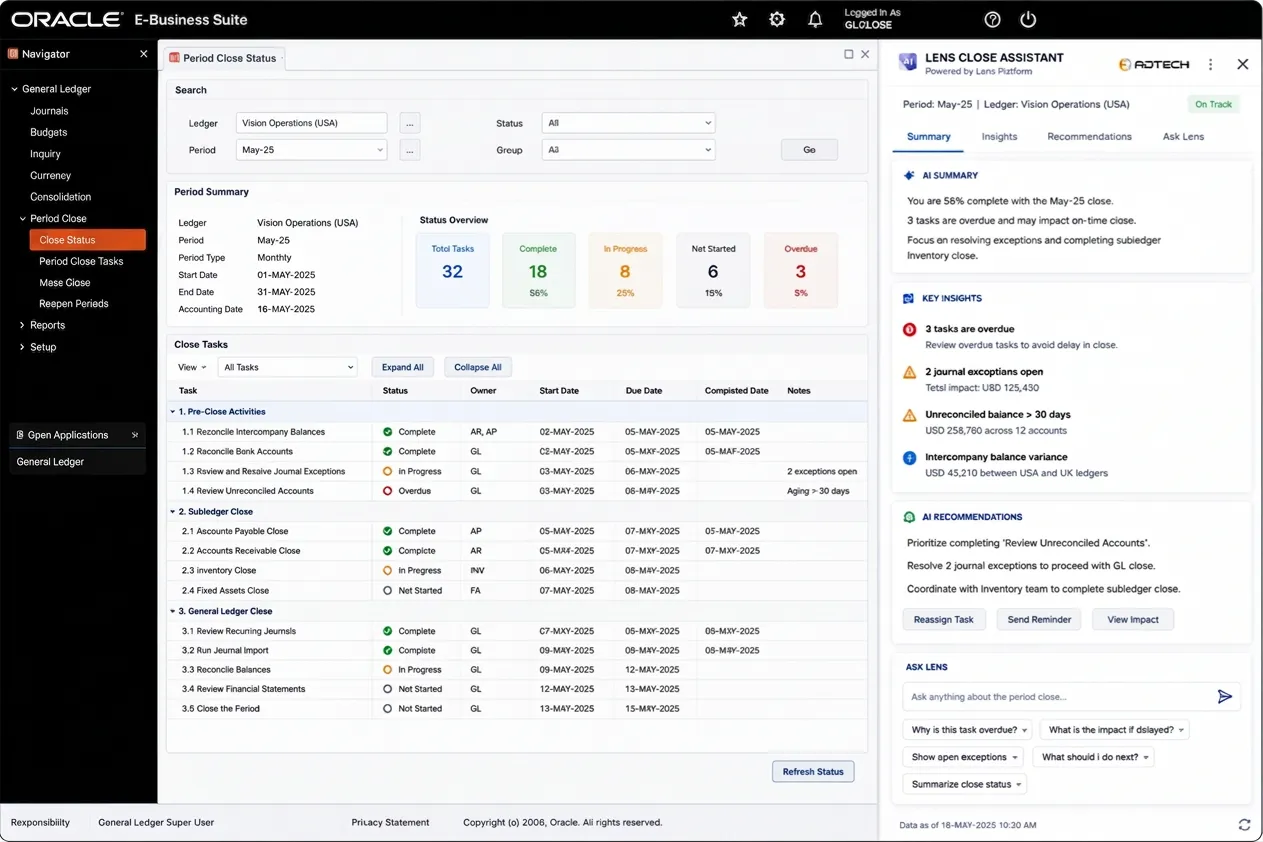
ERPLens dashboard showing AI-powered insights across Oracle E-Business Suite

Integration

Connects natively with SAP, Oracle, Workday, ServiceNow, and Salesforce, with an SDK for anything else you run.

AWS
Google Cloud
Google Drive
Microsoft Azure
Salesforce
Workday
Microsoft Dynamics
Netsuite
Oracle
SAP
Snowflake
Partner Green

More systems, less clarity

Most large companies are not short of data. They are short of anything that can look across all of it at once.

Two things compound. Decisions get made without the full picture: an EY study of 250 UK business leaders found that 71% of high-value decisions were made on incomplete or partial data (EY, November 2025). And the systems keep multiplying: Forrester Consulting put the average large enterprise at 367 software applications, with employees losing about 2.4 hours a day — close to a third of the working week — to finding the information they need to do their jobs (Forrester Consulting for Airtable, December 2022).

That is not a data problem. It is a retrieval problem. ERPLens removes the retrieval step.

An AI workspace layer, not another dashboard

An AI workspace layer reads across every system you already run and gives each role one view of what needs their attention. It does not hold your transactions, and it does not replace your ERP.

ERPLens was built around four things enterprise workers actually need, rather than around adding one more place to look.

Less to hold in your head

One workspace carrying only the signal that matters, instead of everything that could theoretically be relevant.

More confidence in the call

Decisions backed by the full relational picture across systems, not a slice pulled from one of them.

Attention pointed at the right thing

The small fraction of data that needs a human right now, surfaced ahead of the wall of metrics that do not.

Better decisions, not just faster ones

Judgment grounded in how your systems actually connect, rather than in whoever remembered to check.

From your systems to a decision

A continuous flow, not a one-time export.

Your systems

Data sits across SAP, Oracle, Workday, ServiceNow, and whatever else you run. Each holds a piece of the truth, and none of them talk to each other in a way your people can use.

ERPLens

Reads across every connected system, builds a living knowledge graph, and routes it through an AI engine that understands enterprise context.

Business workspaces

Purpose-built views for Collections, Approvals, Procurement, Finance, and Executive teams, showing each role what it needs without the search.

Business outcomes

Movement on the things the business already measures — days sales outstanding, approval cycle time, close duration — because the right information reached the right person at the right moment.

Built for the work your teams actually do

Five workspaces ready to use. If your function is not one of them, you can build it.

Collections

Aging that updates as it changes, disputes routed to whoever can settle them, and a cash forecast built from what is actually likely to land.

Learn more

Approval

Every approval in flight, scored for risk, routed to the right person, and tracked against the time it was meant to take.

Learn more

Procurement

Spend, supplier risk and contract compliance in one view, so problems surface while there is still time to act on them.

Learn more

Finance

Live P&L, a cash forecast you can interrogate, and a close that shows you what it is still waiting on.

Learn more

Executive

The numbers from every function in one place, ready for the review and for the board pack, before either one is due.

Learn more

How this differs from what you already have

The four things ERPLens gets confused with, and where each one stops.

Comparison Dashboard Data warehouse ERP module ERPLens
What it shows you Role-specific actions, ranked by what needs attention Charts and metrics, the same view for everyone Raw or modelled data, built for analysts Transactions within one system
Where the data comes from Reads across all connected systems, live Usually one or a few connected sources Batch-loaded from many sources Only that system’s own data
How current it is Live and continuous Often refreshed on a schedule Depends on load frequency, often hours or days behind Live within that system only
Can it take action Yes, with configurable human approval No, view only No, view only Only within that module’s workflow
Who it is built for Every role, with a workspace tailored to them Whoever built it decided the view Analysts and data teams Users of that system

What runs underneath

Four layers, each solving a different part of the same problem. They are built to work together, and the order matters: nothing above works until the layer below it does.

Data Fabric

Data Fabric

One live connection to every system you run

Most integration projects start by moving data somewhere else. This one does not. The Data Fabric holds live two-way connections to your systems and reads them where they sit, so there is no warehouse to build, no overnight job to wait for, and no second copy of your records to secure and reconcile.

It also writes back. An agent that can only read is a reporting tool. Write-back is what makes it useful.

Book a 45-minute architecture session
Knowledge Graph

Knowledge Graph

How your systems relate, written down where software can read it

Connecting systems is not the same as understanding them. The same customer exists under four different identifiers in four places, and the rules about what may happen to that customer live in a policy document nobody has read since it was written.

The Knowledge Graph resolves those into one map: the entities, how they relate, the policies that govern them, and how all of it has changed over time. That map is the difference between an answer and an explanation.

Book a 45-minute architecture session
AI Intelligence

AI Intelligence

Reasoning grounded in your business, not in general patterns

A general model asked about your business will produce something plausible. That is the problem. ERPLens generates answers against the Knowledge Graph instead, so every claim traces back to a record in a system you own, and the decision logic behaves the same way every time it runs.

An answer your compliance team cannot audit is an answer your compliance team will not let you use.

Book a 45-minute architecture session
Agentic Capabilities

Agentic Capabilities

AI that does the work, not just describes it

Lens Agents act. They take a plain language instruction, carry it through a multi-step workflow, and call real systems to do it. Every action is checked against your approval thresholds, compliance rules, and access boundaries before it executes, not after.

You decide where each workflow sits between recommending and acting, and you can move that line as trust builds. High-stakes actions route to a named person with the full context, and every checkpoint is logged and reversible.

Book a 45-minute architecture session

Frequently asked questions

It is the layer that sits across your existing enterprise systems and gives each person a single place to see what needs them, ask questions in plain English, and take action — without replacing the systems underneath.

See it against your own systems

Forty-five minutes with our architects. No slides — your data schema, your systems, and an honest answer on what would work.

Book a 45-minute architecture session
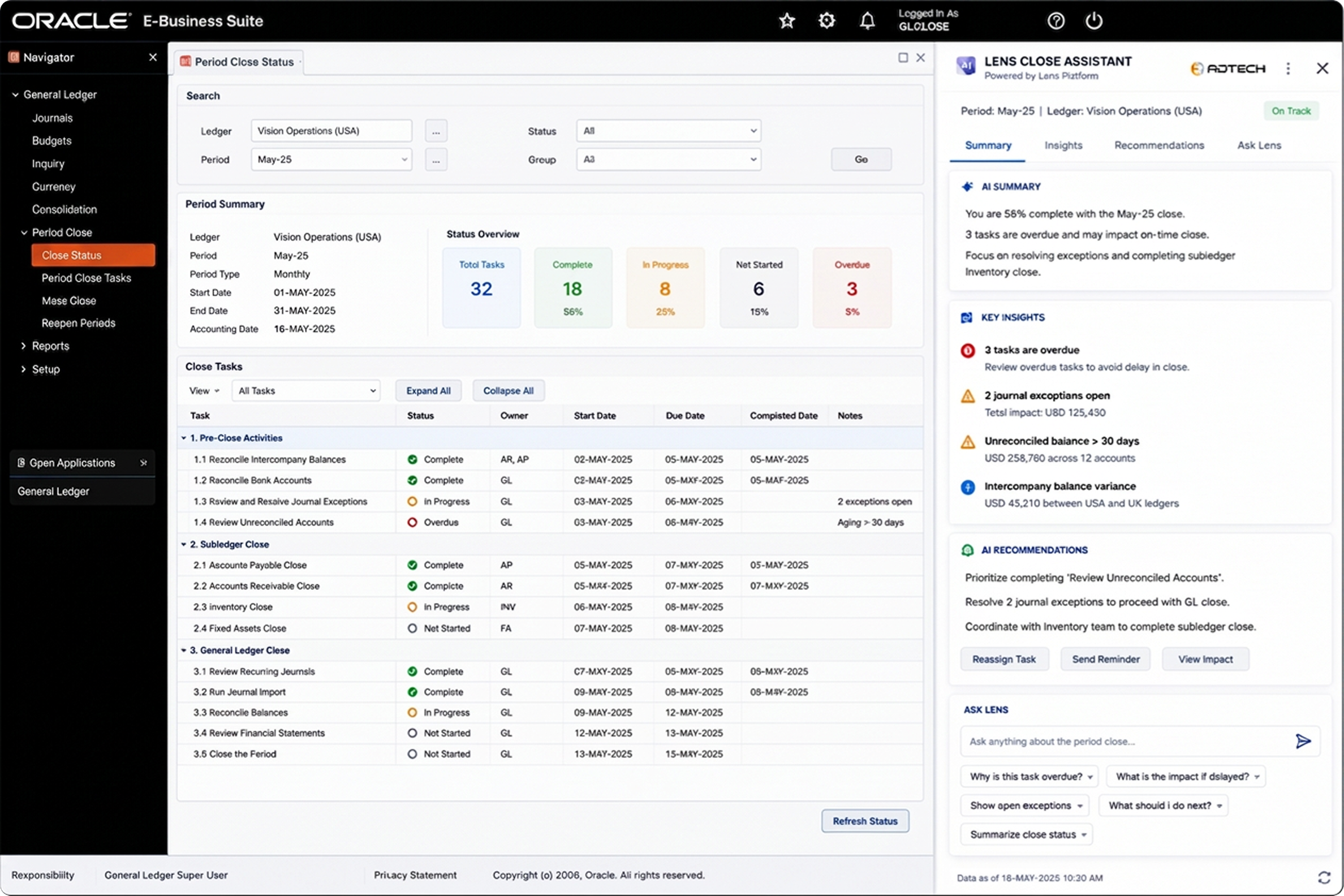
Oracle E-Business Suite period close status enhanced by Lens Close Assistant