Collections
Most companies don’t have a collections problem. They have a visibility problem. The ERP holds the invoice. The CRM holds the relationship history. A separate billing or payment tool holds what’s actually been promised. None of it talks to the others in real time, so an account gets flagged as risky only after it’s already 60 or 90 days out — well past the point where a reminder would have worked. The numbers back this up.
Businesses running manual accounts receivable processes carry roughly
30%
longer average DSO than those with medium-to-high AR automation (PYMNTS and American Express, B2B Payments Innovation Readiness Playbook)
And most companies are still in that gap:
83%
of firms had not fully automated their AR operations as of mid-2025 (PYMNTS Intelligence, “From Friction to Flow: AR Automation in 2025,” June 2025).
Every action ERPLens takes on an account — a reminder sent, a dispute routed, a risk score updated — is logged against that account and timestamped, so what the system touched is always traceable.
Most teams attribute a DSO change by comparing a workspace-connected business unit or credit segment against a control group that hasn't onboarded yet, then track the gap monthly as more accounts move over.
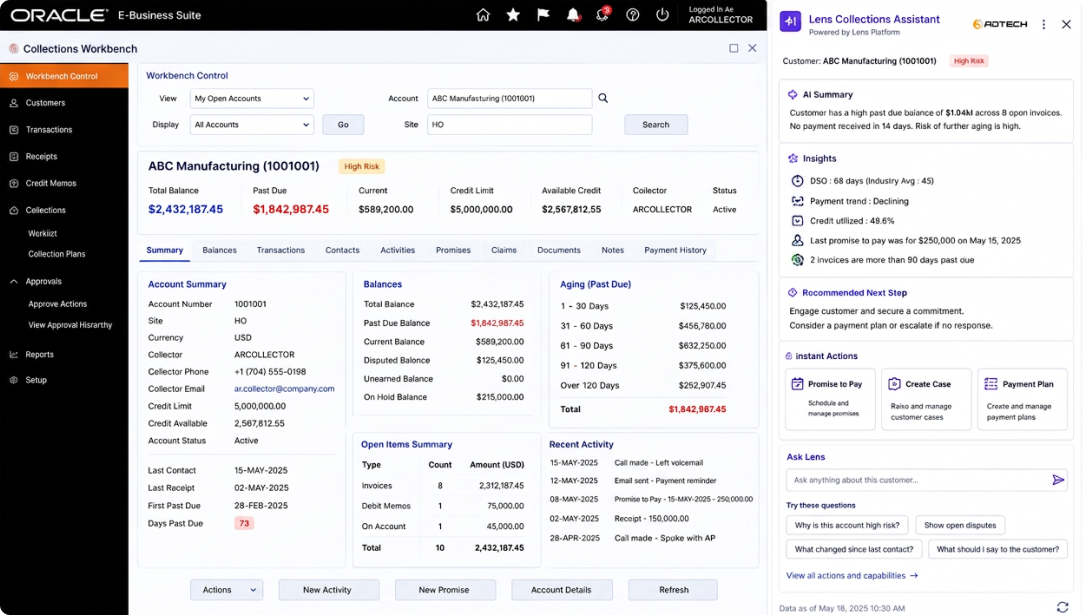
It reads AR, CRM and payment data across your connected systems, ranks overdue accounts by financial risk rather than age alone, and automatically runs the safe, repetitive parts of collections — reminders, dunning, dispute routing — while flagging anything that needs a person.
No. It removes the manual sorting and chasing so your team spends time on accounts that need judgment, not on finding which accounts need attention in the first place.
AR aging and invoice data from your ERP, account and contact history from your CRM, and any credit, dispute, or risk signals you already maintain. Nothing is required beyond what a collections analyst already looks at manually.
No. Write-offs, legal escalation, and credit decisions are configured to require human approval through the policy engine, regardless of how confident the underlying model is.
By comparing DSO for accounts inside a connected workspace against a comparable group that hasn’t onboarded yet, then tracking the gap over time as more of your book moves over.
Your ERP and billing systems for invoice and payment data, your CRM for account history, and your service desk or ticketing tool for disputes — the same connections used across the rest of ERPLens.
Forty-five minutes with our architects. No slides — your AR data, your systems, and an honest answer on what would move and what wouldn’t.
Book a 45-minute architecture session