Finance

Shorten the Close by Removing the Waiting, Not the Checking

Book a 45-minute architecture session
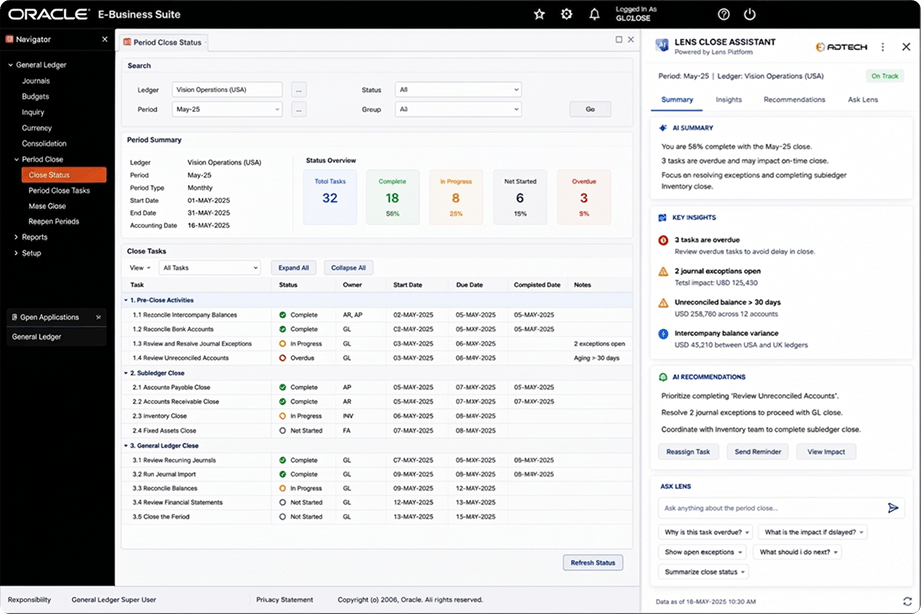
ERPLens workbench across Oracle E-Business Suite with the Lens Assistant

The close doesn’t drag because the accounting is hard

It drags because the data isn’t ready when the accounting starts. Numbers get exported from the ERP, pasted into spreadsheets, chased down from three or four other systems, and reconciled by hand before anyone can look at a figure and trust it.

Half of finance teams take six or more business days to close their books, and only

18%

manage it in three days or fewer (Ledge, Month-End Close Benchmarks for 2025).

Cash reconciliation alone consumes

20-50

hours a month, typically spread across three to five different systems (Ledge, Month-End Close Benchmarks for 2025).

What runs all month, instead of piling up at month end

Continuous

Data collection and reconciliation from connected systems, exception flagging as mismatches occur rather than in a batch at close, and variance tracking against budget or forecast as actuals land.

Still periodic, by design

Journal entry review, management judgment calls, and final sign-off — the parts of the close that need a controller’s judgment stay with your controller.

The data it needs to see

GL and subledger data from your ERP, bank and payment data, and whatever reconciliation sources your team currently stitches together by hand.

What changes for the team

The close starts from numbers that have already been reconciled through the month, instead of starting the reconciliation on day one of the close.

Real-time close status, not a weekly update

Instead of a status update pulled together once a week, the CFO sees close progress — percent complete, open items, aging exceptions — as it happens. Because the same platform runs the Collections, Approvals and Procurement workspaces, issues that affect the close — a disputed receivable, an approval stuck in queue — are visible before they surface as a surprise during close week.

Frequently asked questions

It runs data collection and reconciliation continuously through the month across your connected systems, flags exceptions as they occur, and gives the CFO a live view of close status instead of a periodic update.

See it against your own close

Forty-five minutes with our architects. No slides — your close data, your systems, and an honest answer on what would work.

Book a 45-minute architecture session
Oracle E-Business Suite period close status enhanced by Lens Close Assistant