Collections

See Every Account That’s Slipping — The Day It Slips

Book a 45-minute architecture session
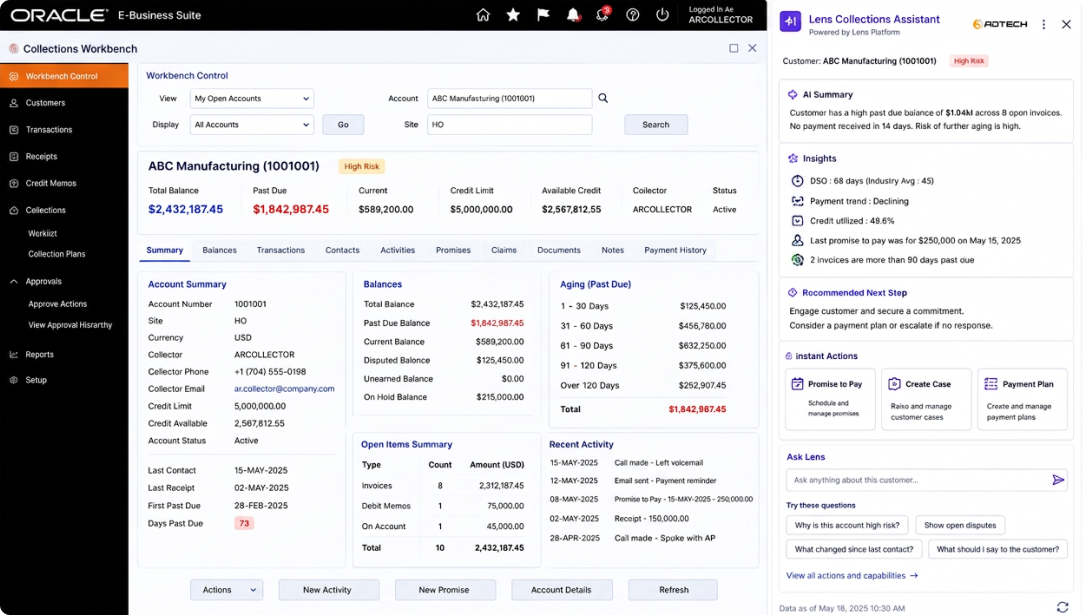
ERPLens workbench across Oracle E-Business Suite with the Lens Assistant

DSO climbs when data doesn’t move

Most companies don’t have a collections problem. They have a visibility problem. The ERP holds the invoice. The CRM holds the relationship history. A separate billing or payment tool holds what’s actually been promised. None of it talks to the others in real time, so an account gets flagged as risky only after it’s already 60 or 90 days out — well past the point where a reminder would have worked. The numbers back this up.

Businesses running manual accounts receivable processes carry roughly

30%

longer average DSO than those with medium-to-high AR automation (PYMNTS and American Express, B2B Payments Innovation Readiness Playbook)

And most companies are still in that gap:

83%

of firms had not fully automated their AR operations as of mid-2025 (PYMNTS Intelligence, “From Friction to Flow: AR Automation in 2025,” June 2025).

What clears itself, and what stays with your team

Safe to automate

Payment reminders, dunning sequences, routing a dispute to the right owner, and re-ranking accounts by risk as new data lands — all handled without waiting on a person.

Stays with a human

Write-offs, legal escalation, credit hold decisions, and anything touching a strategic account — routed through the policy engine and held for human-in-the-loop approval.

The data it needs to see

AR aging from your ERP, payment history and promises-to-pay from your CRM, dispute or ticket status from your service desk, and whatever credit or risk signals you already track.

What changes on day one

Instead of a spreadsheet sorted by days-past-due, Collections sees accounts ranked by who is actually likely to become a problem.

How you’d know ERPLens moved the number

Every action ERPLens takes on an account — a reminder sent, a dispute routed, a risk score updated — is logged against that account and timestamped, so what the system touched is always traceable.

Most teams attribute a DSO change by comparing a workspace-connected business unit or credit segment against a control group that hasn't onboarded yet, then track the gap monthly as more accounts move over.

Frequently asked questions

It reads AR, CRM and payment data across your connected systems, ranks overdue accounts by financial risk rather than age alone, and automatically runs the safe, repetitive parts of collections — reminders, dunning, dispute routing — while flagging anything that needs a person.

See it against your own receivables

Forty-five minutes with our architects. No slides — your AR data, your systems, and an honest answer on what would move and what wouldn’t.

Book a 45-minute architecture session
Oracle E-Business Suite period close status enhanced by Lens Close Assistant